As an Amazon Associate, Noted Deals earns from qualifying purchases. Disclosure
Most homes should buy a robot vacuum with LiDAR mapping and a self-emptying dock, and the one to get is the Roborock Q10 S5+: it maps the house with a spinning laser, watches for small obstacles in its path, empties itself into a bag that Roborock says lasts up to seven weeks, and lifts its mop when it reaches a rug. Spend less only if you'll accept a mop that you attach and remove by hand. Spend much more only if you want the robot to mop every day without you touching a wet pad.
The dock is where the money goes, and it's the decision that matters most. A charging-only dock means you empty a cup-sized bin after almost every run, which is the chore that makes people stop running their robot. A self-emptying dock moves that dirt into a sealed bag and turns the chore into a monthly one. A full washing dock adds clean and dirty water tanks, washes and dries the mop pads, and costs two to three times as much. Our picks cover each step, so you can buy exactly as much dock as you'll use.
The number printed biggest on every box, the suction in pascals, is the one we weighed least. Makers measure it in different ways, and only some say how. A robot's height, its battery, the size of the threshold it can climb and what it does with a wet mop on carpet tell you far more about how it will live in your home.
We compared current robot vacuums from Roborock and TP-Link's Tapo line using each maker's product page, spec sheet and FAQ, checking what changed between this year's models and the ones they replace. The ones we passed over, and why, are at the end.
Our picks
4 products-
 1Best for most people
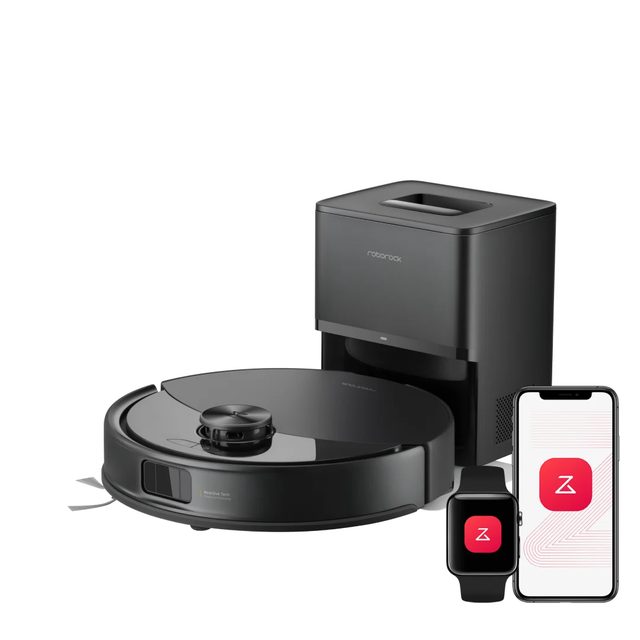
Roborock Q10 S5+ Robot Vacuum and Mop with Auto-Empty Dock
Check price on AmazonList price at us.roborock.com$549.99As of October 19, 2026. Amazon's price may differ.
-
 2Best on a tight budget
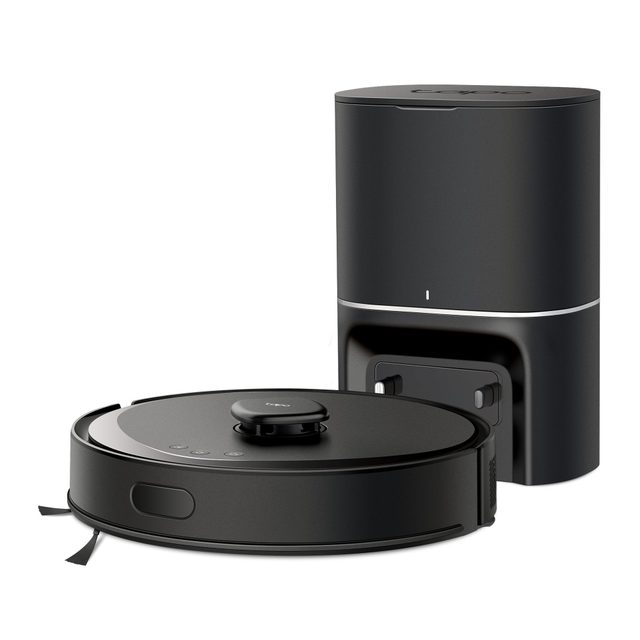
Tapo RV30 Max Plus Robot Vacuum and Mop with Auto-Empty Dock
Check price on AmazonList price at tp-link.com$329.99As of October 19, 2026. Amazon's price may differ.
-
 3Best for mopping
Tapo RV50 Pro Omni Robot Vacuum and Mop with Self-Emptying Dock
Check price on AmazonList price at us.store.tapo.com$699.99As of October 19, 2026. Amazon's price may differ.
-
 4Best for low furniture and rugs
Roborock Saros 10R Robot Vacuum with Multifunctional Dock 4.0
Check price on AmazonList price at us.roborock.com$1,599.99As of October 19, 2026. Amazon's price may differ.
Paid link. We may earn a commission; your price is the same.
How they compare
From each maker's published specifications, checked October 19, 2026.
| Spec |
Q10 S5+ |
RV30 Max Plus |
RV50 Pro Omni |
Saros 10R |
|---|---|---|---|---|
| Best for | Best for most people | Best on a tight budget | Best for mopping | Best for low furniture and rugs |
| Height | 3.9 in | 3.9 in | 3.95 in | 3.14 in |
| Battery | 5,200 | 2,600 | 5,200 | 6,400 |
| Threshold it climbs | — | 0.87 in | 0.78 in | 1.57 in |
| Days between bag checks | Up to 7 weeks | Up to 2 months | Up to 60 days | — |
| List price | $549.99us.roborock.com | $329.99tp-link.com | $699.99us.store.tapo.com | $1,599.99us.roborock.com |
| On Amazon | Amazon | Amazon | Amazon | Amazon |
1Best for most people
Roborock Q10 S5+ Robot Vacuum and Mop with Auto-Empty Dock
- Hands-free dirt storage
- Up to 7 weeks
- Battery
- 5,200 mAh, up to 150 min
- Height
- 3.9 in
Paid link. We may earn a commission; your price is the same.
This is the robot that does the whole job without asking much of you. A PreciSense LiDAR turret on top spins a laser to map each room, so it cleans in straight rows and knows where it has been, and it stores up to four maps for a house with several floors. Roborock's ReactiveTech sensors watch for small objects in its path, the thing that separates a robot you can run while you're out from one you have to babysit.
The dock is the reason it earns the top spot. After each run the RockDock Plus pulls the robot's dirt into a 2.7-liter bag that Roborock says lasts up to seven weeks. Its mop uses VibraRise 2.0, a pad that vibrates against the floor instead of only dragging across it, and it lifts on its own when the robot detects carpet, so a rug in the middle of a kitchen stays dry. The 5,200mAh battery gives up to 150 minutes on Roborock's own test, enough for most homes in one go.
The Tapo RV30 Max Plus below matches the self-emptying idea and the LiDAR map for less, but its mop can't lift and its battery is half the size. The Tapo RV50 Pro Omni costs more because its dock does the mop chores too. The Q10 S5+ sits in the middle: you still fill the robot's water tank and rinse its pad, and for that you get a small dock (about 8 by 7 by 10 inches) that fits beside a sofa.
Good
- LiDAR mapping with up to four saved floors
- The dock holds up to seven weeks of dirt, by Roborock's test
- The mop vibrates to scrub, and lifts itself on carpet
- A dock small enough to hide beside furniture
Worth knowing
- You fill the water tank and wash the mop pad yourself
- At 3.9 inches tall, it won't fit under low sofas
- Roborock doesn't publish the threshold height it can climb
- Roborock doesn't publish a noise level
All specs
- Hands-free dirt storageUp to 7 weeks
- Battery5,200 mAh, up to 150 min
- Height3.9 in
- Suction (maker)10,000 Pa
- NavigationPreciSense LiDAR
- Obstacle avoidanceReactiveTech
- MopVibraRise 2.0, lifts on carpet
- Dock bag2.7 L
- Robot size13.9 x 13.9 x 3.9 in
- Dock size8.35 x 7.01 x 10.2 in
- Robot weight14.8 lb
From us.roborock.com, checked October 19, 2026.
2Best on a tight budget
Tapo RV30 Max Plus Robot Vacuum and Mop with Auto-Empty Dock
- Hands-free dirt storage
- Up to 2 months
- Battery
- 2,600 mAh
- Height
- 3.9 in
Paid link. We may earn a commission; your price is the same.
If you want a robot that maps and empties itself and you'll mop by hand, this is the one to buy. TP-Link pairs a LiDAR turret with an IMU motion sensor for its maps, and the dock pulls each run's dirt into a 3-liter sealed bag that TP-Link says holds up to two months of it. The robot's own bin is 300 milliliters, so that bag is about ten full bins you never touch.
It lists for about 60 percent of what the Q10 S5+ does, and the savings show in three places. The battery is 2,600mAh, half the Roborock's, and TP-Link's pages give its runtime two ways, 150 minutes on one chart and three hours on the spec sheet. The mop is a flat plate that drags a damp cloth and can't lift: in mopping mode the robot avoids the carpets you've marked on its map rather than raising the pad. And TP-Link describes its obstacle avoidance only in general terms, where the RV50 Pro Omni names front and side lasers.
TP-Link publishes figures the others skip. It rates the robot at 52 dB in quiet mode and 55 dB in its default mode, about the level of ordinary conversation, and says it climbs a 0.87-inch threshold, which covers most doorway strips. For an apartment with hard floors and a few rugs, those numbers are enough.
Good
- Self-emptying with a 3 L bag, at a budget price
- LiDAR mapping, with up to four floor maps
- TP-Link publishes its noise level: 52 to 55 dB
- Climbs a 0.87-inch threshold
Worth knowing
- The mop can't lift; it steers around carpets you've mapped instead
- Half the battery of the other picks here
- TP-Link lists its runtime as both 150 minutes and three hours
- No named front obstacle sensor, unlike the RV50 Pro Omni
All specs
- Hands-free dirt storageUp to 2 months
- Battery2,600 mAh
- Height3.9 in
- Suction (maker)5,300 Pa
- NavigationLiDAR + IMU
- MopPlate mop, 300 ml tank, no lift
- Dock bag3 L
- Noise52 dB quiet, 55 dB standard
- Climbs0.87 in (22 mm)
- Dock size9 x 6.5 x 13 in
- FilterH11 HEPA
From tp-link.com, checked October 19, 2026.
3Best for mopping
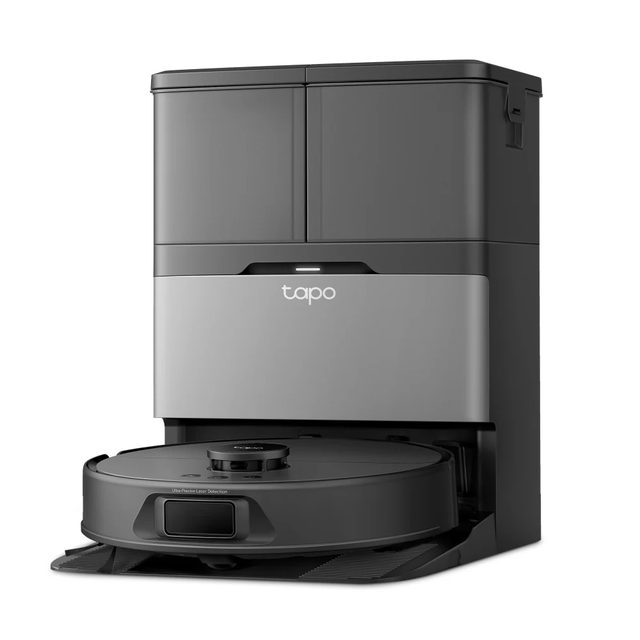
Tapo RV50 Pro Omni Robot Vacuum and Mop with Self-Emptying Dock
- Hands-free dirt storage
- Up to 60 days
- Battery
- 5,200 mAh, up to 250 min
- Height
- 3.95 in
Paid link. We may earn a commission; your price is the same.
Buy this one if your floors are mostly tile, wood or vinyl and you want them mopped as often as they're vacuumed. Its dock does seven jobs: it empties the robot into a 3-liter bag (up to 60 days, TP-Link says), washes the two spinning mop pads in 140°F water, dries them with 122°F air so they don't sour, adds floor cleaner from its own reservoir and refills the robot from a 5-liter clean tank. Dirty water goes into a separate 4-liter tank you pour out.
It handles carpet better than either robot above. On thin rugs it lifts the wet pads 0.47 inch; for thick carpet it leaves both pads at the dock and goes back out to vacuum dry. An arm called DeepEdge swings out to mop along baseboards, the strip a round robot usually misses. Front and side lasers steer it around cables, socks and pet toys, and a cutting brush at the dock trims hair that wraps the roller.
The catch is size. The dock measures 13.8 by 18.7 by 18.9 inches, about the footprint of a small side table, and it needs a spot near an outlet where you can reach both water tanks. It's the newest robot in Tapo's US line, and it lists for less than half of what the Saros 10R does with a dock that covers most of the same chores.
Good
- Washes mops in 140°F water and dries them with warm air
- Adds floor cleaner and refills water by itself
- Drops its mops at the dock before vacuuming thick carpet
- Up to 250 minutes of runtime, by TP-Link's test
- Works with Matter, Alexa and Google
Worth knowing
- The dock is about 19 inches tall and wide; plan its spot
- You still empty the dirty-water tank and refill the clean one
- TP-Link doesn't publish its noise level or weight
- A new model, with no long track record yet
All specs
- Hands-free dirt storageUp to 60 days
- Battery5,200 mAh, up to 250 min
- Height3.95 in
- Suction (maker)15,000 Pa
- Mop wash / dry140°F water / 122°F air
- Water tanks5 L clean, 4 L dirty
- Mop lift0.47 in, or left at the dock
- NavigationLiDAR + dual-laser avoidance
- Climbs0.78 in (20 mm)
- Dock size13.8 x 18.7 x 18.9 in
- FilterH11 HEPA
From us.store.tapo.com, checked October 19, 2026.
4Best for low furniture and rugs
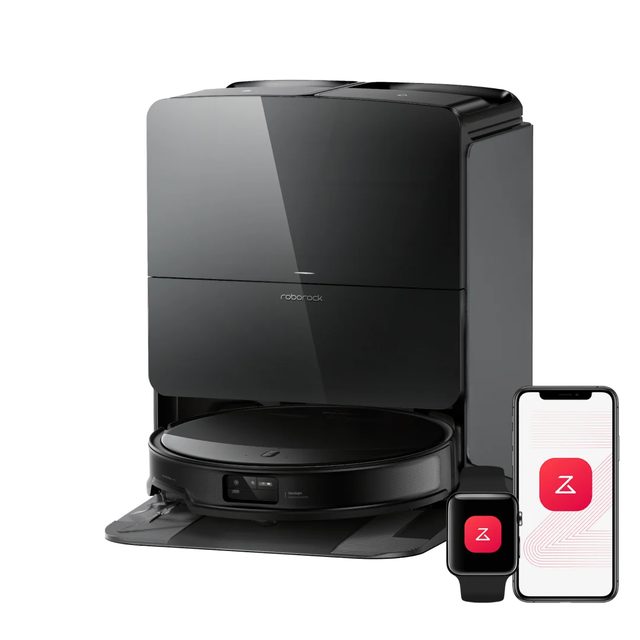
Roborock Saros 10R Robot Vacuum with Multifunctional Dock 4.0
- Height
- 3.14 in
- Climbs
- Up to 1.57 in (4 cm)
- Battery
- 6,400 mAh
Paid link. We may earn a commission; your price is the same.
The Saros 10R solves the two problems the cheaper robots can't. It is 3.14 inches tall, three-quarters of an inch lower than the others here, because it maps with a 3D time-of-flight sensor instead of a LiDAR turret on top. That inch is the difference between cleaning under a low sofa or bed and bumping into it. And its chassis lifts itself 10 millimeters to climb thresholds up to about 1.5 inches (4 centimeters), the double-height door strips and rug edges that strand most robots.
It treats carpet carefully too. The two spinning mops lift 17 millimeters (about two-thirds of an inch) over rugs, and when it vacuums carpet it leaves its mop mounts at the dock. The dock washes the mops in 176°F water, the hottest here, dries them with hot air on a two-, three- or four-hour setting and empties the robot's dirt. An RGB camera and Roborock's VertiBeam side sensor handle obstacles, and the DuoDivide main brush is built so hair doesn't wrap around it.
It lists for more than twice the Tapo RV50 Pro Omni, and most of what you're paying for is the height and the climbing. If your sofas clear four inches and your thresholds are flat, the Tapo does nearly the same chores. If they don't, the Saros 10R is the only robot here that will reach those spots.
Good
- 3.14 inches tall: fits under low sofas and beds
- Climbs thresholds up to about 1.5 inches
- Washes mops in 176°F water and dries them with hot air
- Leaves its mops at the dock for carpet
- A 6,400 mAh battery, the largest here
Worth knowing
- The highest list price here by a wide margin
- Roborock's US page doesn't give a suction or runtime figure
- The dock alone weighs about 25 pounds
- Wi-Fi setup works on 2.4 GHz networks only
All specs
- Height3.14 in
- ClimbsUp to 1.57 in (4 cm)
- Battery6,400 mAh
- Navigation3D ToF + RGB camera
- Mop wash176°F water, hot-air drying
- Mop lift17 mm, or left at the dock
- Chassis lift10 mm
- Charging2.5 hours
- Robot weight9.04 lb
- Dock weight25.13 lb
From us.roborock.com, checked October 19, 2026.
How to choose a robot vacuum
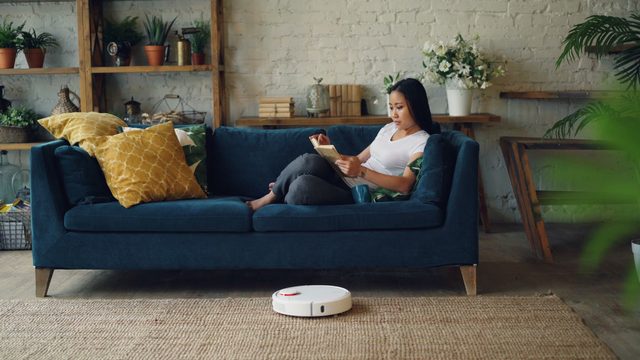
Start with the dock, because it decides how often you deal with the robot. Then check the four numbers below against your home.
- Dock. Charging-only means emptying the bin after almost every run. Self-emptying (the Q10 S5+ and RV30 Max Plus) means changing a bag every month or two. A washing dock (the RV50 Pro Omni and Saros 10R) also cleans and dries the mops, and needs a floor spot about the size of a side table.
- Navigation. Buy LiDAR or an equivalent laser sensor. A robot that maps the room cleans in rows, goes back to the dock on its own and lets you block off a pet bowl or a tangle of cables in the app. Every pick here maps.
- Height. Measure the gap under your lowest sofa, bed and cabinet. A robot needs its full height plus a little room to get under. Most are about 3.9 inches; the Saros 10R is 3.14.
- Thresholds. Measure your tallest door strip and rug edge. Under three-quarters of an inch, any robot here will cross it. Taller than that, only the Saros 10R is built for it.
- Mop and carpet. A mop that drags across a rug leaves it damp. The simplest answer is a robot that steers around carpets you've marked on the map; the best is one that lifts its pads or leaves them at the dock.
Ignore the suction figure on the box. Roborock says its numbers come from a standard lab test (IEC 62885-2) at maximum power with a full battery; TP-Link doesn't say how it measures. Pascals from two makers aren't comparable, and past a few thousand they tell you little about how clean a floor gets.
Do you need a self-emptying dock?
For most people, yes, and it's the upgrade we'd make before any other. A robot's own bin is small: the RV30 Max Plus holds 300 milliliters, about a cup and a quarter. In a home with a shedding dog, that fills in a single run, and a robot with a full bin stops picking up. A self-emptying dock moves each run's dirt into a sealed bag ten times that size, so the robot starts every clean empty.
There are two reasons to skip it. If you live in a small apartment and will run the robot two or three times a week, emptying a bin is a short chore. And the bags are a running cost: each dock uses its own replacement bags, sold in packs by Roborock and TP-Link, and you'll go through six to eight a year.
Care and upkeep
A robot vacuum needs a few minutes every week or two, whichever dock you buy.
- Brushes. Pull hair off the main brush and side brush every couple of weeks, even on anti-tangle models. Both makers sell replacement brushes, side brushes and filters as kits.
- Filter. Tap the dust out of the filter when you change the bag. Both Tapo robots here use an H11 HEPA filter.
- Sensors. Wipe the LiDAR window and the cliff sensors underneath with a dry cloth. A dusty cliff sensor can make a robot think it's at the top of the stairs.
- Washing docks. Empty the dirty-water tank after a few runs, rinse it and refill the clean tank. Roborock and TP-Link each sell a floor cleaner made for their docks; we'd use that or plain water.
- Mop pads. On the Q10 S5+ and RV30 Max Plus, rinse the cloth pad after each mopping run and let it dry before it goes back on. Both makers sell spare washable cloths, so you can rotate two.
What we left out, and why
- Roborock Q10 X5+: the same size, dock and LiDAR as the Q10 S5+, but its mop drags a cloth instead of vibrating. It lists for less, and if you rarely mop, it's a fair swap.
- Roborock Q7 M5+: an older, smaller self-emptying robot with a 3,200mAh battery and a mop that doesn't lift. The Tapo RV30 Max Plus does the same job for less.
- Tapo RV20 Max and RV20 Max Plus: slimmer, at 3.27 inches, but both showed as unavailable on TP-Link's US store when we checked, so we couldn't recommend them.
- Roborock Q10 S5 and Q10 X5 (no dock): also unavailable on Roborock's US store when we checked, and we'd pay for the dock anyway.
- Roborock Qrevo S5V: a full washing dock with 12,000 Pa suction, but it lists for more than the Tapo RV50 Pro Omni, and at that money we'd rather pay for the Saros 10R's height and climbing.
- eufy, Shark and iRobot: we didn't include them this time. Their US lineups and model numbers vary from one retailer to the next, and we'll add them once we've read each spec sheet in full.
Questions people ask
Do robot vacuums work on carpet?
Yes, on low and medium pile. The Q10 S5+ and both Tapo robots raise their suction on carpet automatically. Thick shag and rugs with long tassels are the exception: robots can stall on them, so mark them as no-go zones in the app. If you mop, choose a robot that lifts its mop or leaves it at the dock, or one that steers around the carpets on its map.
Can a robot vacuum replace a regular vacuum?
For daily floor cleaning, mostly. A robot that runs every day keeps crumbs, dust and pet hair under control better than a big vacuum once a week. It can't do stairs, upholstery, the inside of a car or a deep spring clean, so keep a cordless stick or a small upright for those.
Why won't my robot vacuum connect to my Wi-Fi?
Most robot vacuums connect only to a 2.4 GHz network, and TP-Link and Roborock say so for the robots here. If your router combines 2.4 and 5 GHz under one name, setup can fail. Many routers let you turn on a separate 2.4 GHz network in their settings; connect your phone and the robot to it for setup.
How often should a robot vacuum run?
Daily, in a home with pets or kids; two or three times a week otherwise. Set a schedule in the app for a time when no one is home and the floors are clear, and the robot keeps up so you rarely need a deep clean.
Is a higher suction number better?
Only within one brand. Makers measure pascals in different ways, and not all of them say how, so 15,000 Pa from one company and 10,000 Pa from another don't compare. Mapping, the brush design and whether the robot runs with an empty bin matter more to how clean the floor gets.